
Why Electric Hot Air Instead of Flame, Platen, or Radient Heat
Hot-air sealing already won this argument in most of the industry, but the reasons are worth restating because they are the same reasons to choose a well-built electric air heater over a marginal one. Open flame has no place near PE-coated food packaging. It puts combustion byproducts directly into the air that touches the inside surface of a cup or a carton flap, it needs fuel plumbing and flue arrangements inside a food plant, and it cannot be closed-loop controlled to a few degrees. Electric resistance heating of a clean compressed-air or blower-air stream adds nothing to the air but heat. There is no flue, no fuel permit and no combustion air balance to maintain.
Heated platens and sealing bars work by conduction, so they have to touch the board. That makes them slow to reach the seal temperature, prone to sticking molten PE to the tool face, and awkward on a three-dimensional gable top where the geometry is not flat. Hot air reaches into the fold and the corner, and it only heats where the nozzle points. Infrared is non-contact but it heats by absorption, and PE coatings, inks and board colors absorb differently. A dark printed panel and a white panel under the same IR emitter reach different temperatures. Hot air at a known outlet temperature and known flow delivers a repeatable energy dose regardless of what is printed on the blank. Against steam or hot-oil heating, electric wins on temperature range alone. PE activation needs air well above 300 C, which is out of reach for steam, and electric air heaters reach it in seconds from cold.
- No combustion byproducts in the airstream that touches food-contact packaging
- Closed-loop control on the air temperature itself, with thermocouple feedback at the heater outlet
- Fast ramp from cold, so the first cartons after a changeover are inside the seal window
- Compact in-station footprint with no fuel line, flue, burner management or permit
- Non-contact, so no molten PE transfer to a tool face and no geometry limits on gable folds
- Repeatable energy dose independent of ink coverage or board color, unlike radiant heating
- Element-level replaceability: a Serpentine VI cartridge changes out without rebuilding the station
Real-World Applications
Gable-Top Carton Bottom and Top Sealing
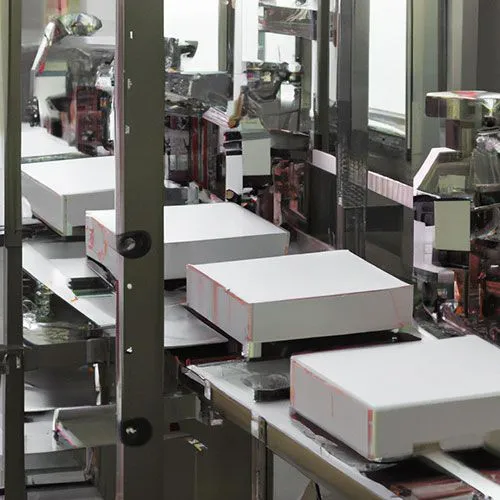
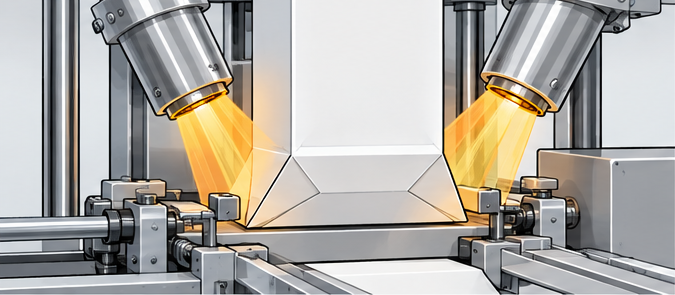
This is the classic installation. A flat PE-coated blank is formed into a sleeve, the bottom is folded and sealed, the carton is filled, and the gable top is folded and sealed. Separate bottom and top heater ovens blow hot air in a selective pattern onto the flaps so the coating melts only where the seal will be, then pneumatic high-compression jaws close the joint. Published machine documentation in this sector describes exactly this arrangement, including ovens that retract automatically when the machine stops and an air knife that protects the cartons from overheating. The scheme is standard across gable-top platforms worldwide, from the established European, North American and Japanese builders to the large group of machine makers in China, India and Turkey. The SureHeat element is the electric heater inside those ovens: it raises the compressed-air stream to the activation temperature, typically 300 to 450 C, and holds it against a stop-start duty cycle.
Paper Cup Sidewall Seam and Bottom Sealing
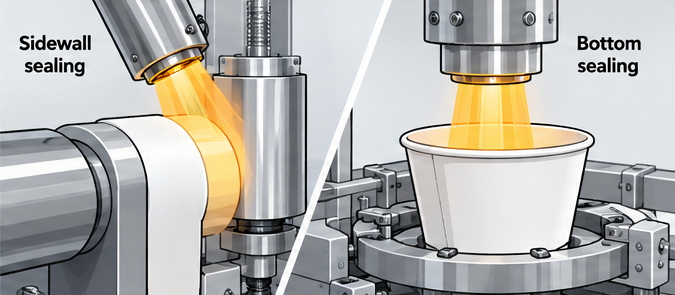
A cup machine does two hot-air jobs in quick succession. The fan blank is wrapped around a mandrel and the overlapping side seam is sealed, often with hot air preheating the PE before an ultrasonic or mechanical seal closes it. Then the bottom disc is set into the sleeve and a second hot-air nozzle heats the disc and the skirt before the bottom is knurled and rolled. High-speed cup machines, whether from the long-established Western builders or the large group of Chinese and Taiwanese manufacturers, run both stations, typically between 300 and 500 C. Two heaters per machine is common, one for the sleeve and one for the bottom, each on its own control loop because the two joints have different board thickness and different dwell.
Paper Bowl, Lid and Container Forming
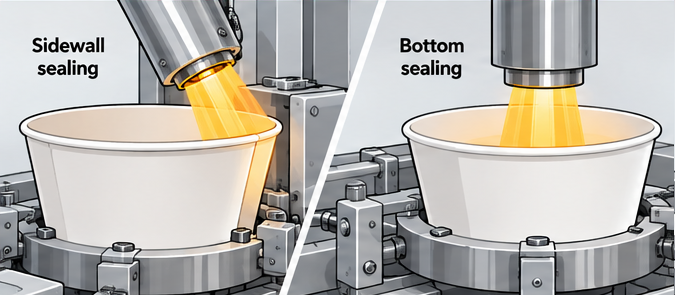
Bowls, noodle containers, ice cream tubs and lunch boxes are the same physics at different geometry. The board is heavier, sometimes double-PE coated, and the seal path is longer. Machine builders in this group specify hot air by board weight, with a PLC setpoint per product, and often fit two independent hot-air systems so the sidewall and the bottom can be tuned separately. Double-wall and insulated cups add a second shell and a second seal. Because the board weight changes between products, the heater and its controller have to hold a setpoint across a wide range of flows and recipes rather than at one operating point.
Aseptic Carton Sealing and Sterile Hot Air
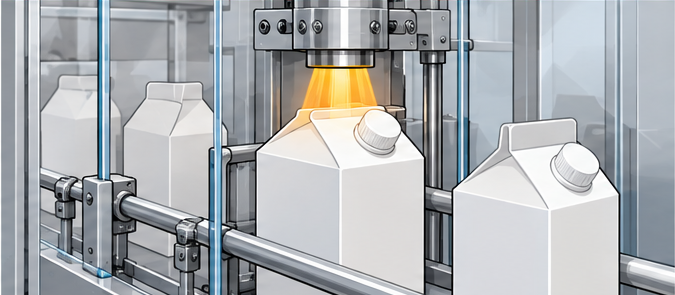
Aseptic lines seal the same PE coating but inside a sterile zone, and the hot air can serve more than one purpose. Sleeve-fed aseptic fillers activate the PE on the carton bottom as the sleeve is formed and sealed, with the top sealed ultrasonically. Some lines also use hot sterile air for drying after a chemical sterilant step. In both cases the air must carry nothing but heat. Electric resistance heating satisfies that by construction. For the higher-temperature and higher-pressure parts of this duty, SFI inline heaters and SureHeat MAX are the right families.
Flat-Blank Container Corner Sealing
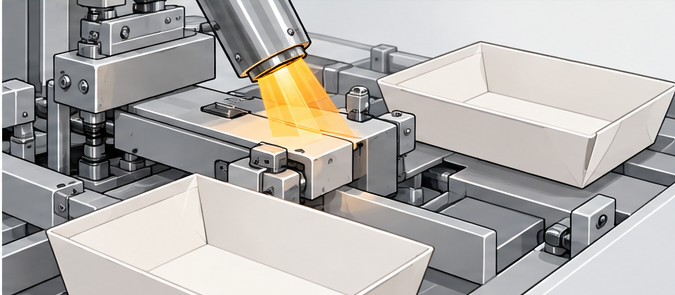
Paper lunch boxes, food boxes and trays made from PE-coated board are sealed at the corners rather than on a continuous seam. Builders in Taiwan and Korea publish hot-air heater sealing as the method: a nozzle melts the PE on the corner tabs and the folding tool closes them. The seal area is small, the cycle is fast and the heater is close to the tooling, so a compact single-element heater with a short duct is the usual fit. This is the application where nozzle standoff and nozzle cleanliness matter most, because the heated area is only a few millimeters wide.
Replacement Elements for Installed Machines
Most of the demand in this sector is not for new machines. It is for the hot-air element that failed on a cup machine or a carton filler already running three shifts. These stations were built around a compact electric air heater, and the replacement question is mechanical and electrical fit, not physics: station envelope, mounting detail, nozzle arrangement, available voltage, airflow and setpoint. Serpentine and Serpentine VI replacement elements, and JET or MAX assemblies, are specified against those six numbers. Matching SureHeat control panels can be supplied with them where the original controller is also at end of life.
Get Started on Heating Solutions
Hot-air sealing is a mature process, and the heater is usually the only part of it that still gets replaced on a schedule. If you build carton or cup machines, TUTCO SureHeat can supply the air heater as a designed-in component: element rating matched to your nozzle count and line speed, housing sized to the station envelope, thermocouples and controller selected so the seal window holds through startup and stop-start production. If you run the machines, we can supply Serpentine and Serpentine VI replacement elements and JET or MAX assemblies that drop into existing hot-air seal stations, with the control hardware to go with them. TUTCO SureHeat has built electric air heaters for OEM production equipment for more than 25 years, from a few kilowatts to multi-megawatt systems. Send us the station details: nozzle configuration, available voltage, airflow, cycle rate and the board you are sealing. We will tell you which family fits and what it will hold.
Get A Quote Triple-Pass Heaters - Serpentine VI
 Solving Heating Challenge with the Serpentine II
 SureHeat Jet vs. Max Air Heaters
 Serpentine™ Technology Offers Higher Temperatures
Frequently Asked Questions
Yes. SureHeat control panels are matched to the heater family. Serpentine VI is specified with digital temperature controllers using Type K thermocouples, and JET and MAX assemblies include dual Type K thermocouples with over-temperature protection. For a multi-station machine, each seal station should be controlled on its own loop so one nozzle does not set the temperature for all of them.
Electric resistance heating adds no combustion products to the airstream. Whatever enters the heater is what leaves it, at a higher temperature. The cleanliness of the air is therefore set by your supply: filtered compressed air or a filtered blower feed. For sterile hot air on aseptic carton lines, SFI inline heaters and SureHeat MAX handle the higher temperature and pressure duty, and the airstream stays clean because nothing is burned in it.
That is the normal duty for this equipment, and it is what the element construction has to be chosen for. Open-coil Serpentine elements have low thermal mass, which is why they ramp fast, and they are built to be cycled. Pair the heater with a controller that holds a standby setpoint during short stops rather than switching fully off, and the element sees a much gentler cycle while the station still comes back to the seal window in seconds.
Three causes dominate in this application. First, cycling: every stop-start or oven retraction is a thermal cycle on the element. Second, flow loss: a blocked filter, a kinked hose or a partly plugged nozzle starves the element while the controller keeps calling for heat, which drives the coil above its rating even though the measured outlet air looks normal. Third, contamination: board dust, paper fiber and PE vapor drawn into the inlet or deposited on the nozzle. Guarantee minimum flow, filter the inlet and keep the nozzle clean, and element life improves without changing anything else.
It depends on airflow and target temperature, not on the board. Work it from the mass flow through the nozzle and the required temperature rise, then add margin for the duty cycle. For reference, SureHeat JET is offered in 3 kW and 8 kW, Serpentine VI in 5.0, 6.0 and 8.0 kW, and SureHeat MAX from 6 kW to 36 kW with up to six elements. A single cup-machine bottom nozzle usually sits at the low end; a multi-lane gable-top oven manifold is where MAX becomes the right answer.
Serpentine VI is rated to 1500 F (815 C) outlet air, in 5.0 kW, 6.0 kW and 8.0 kW power options, with a 240 V single-phase configuration listed, a maximum inlet pressure of 25 psi, a 304 stainless steel housing and a minimum flow of 60 SCFH for accurate control. It uses a triple-pass open-coil Serpentine element in a compact modular package.
Usually yes. Serpentine and Serpentine VI elements and JET and MAX assemblies are built to the same job description as the compact hot-air heaters commonly fitted to cup and carton machines: electrically heat a flowing air stream to several hundred degrees Celsius and hold it. Replacement is a mechanical and electrical fit question. Send us the station envelope, the mounting detail, the nozzle arrangement, the available voltage and the airflow, and we will confirm the fit.
Machine builders in this sector typically run 300 to 450 C (570 to 840 F) at the heater outlet for gable-top flap sealing, and typically 300 to 500 C (570 to 930 F) for paper cup sidewall and bottom sealing. These are industry-typical operating ranges rather than published figures from the machine builders. The board surface itself never reaches those numbers because contact time is well under a second. Start from the range, then tune to your board weight, coating thickness, nozzle standoff and line speed.
